I was fine—or so I thought. “It’s just a cold,” I tried to convince myself while symptoms kept worsening over several days. I was more focused on getting it over with and resuming my planning for an upcoming music tour—something I’d worked for the entire past year.
On a fateful Saturday, I vomited blood—again. I couldn’t breathe anymore, and my fingertips turned blue. My heart was racing, and I couldn’t tolerate any food or beverages. My wife promptly called an ambulance, and I was sent to a local hospital. The situation escalated rapidly, and they couldn’t stabilize me. The last thing I remembered was being on an oxygen mask. Then, everything went black.
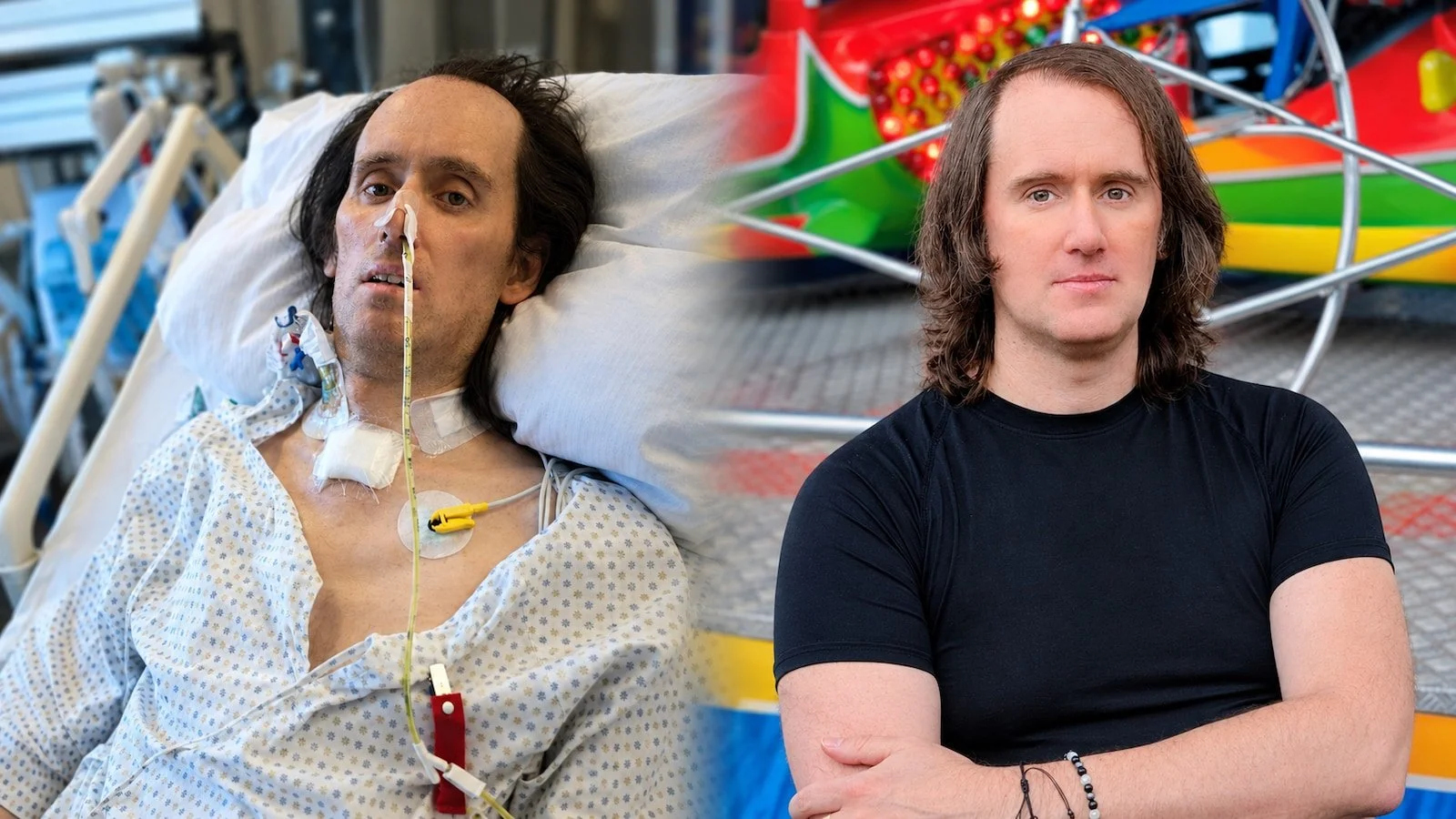
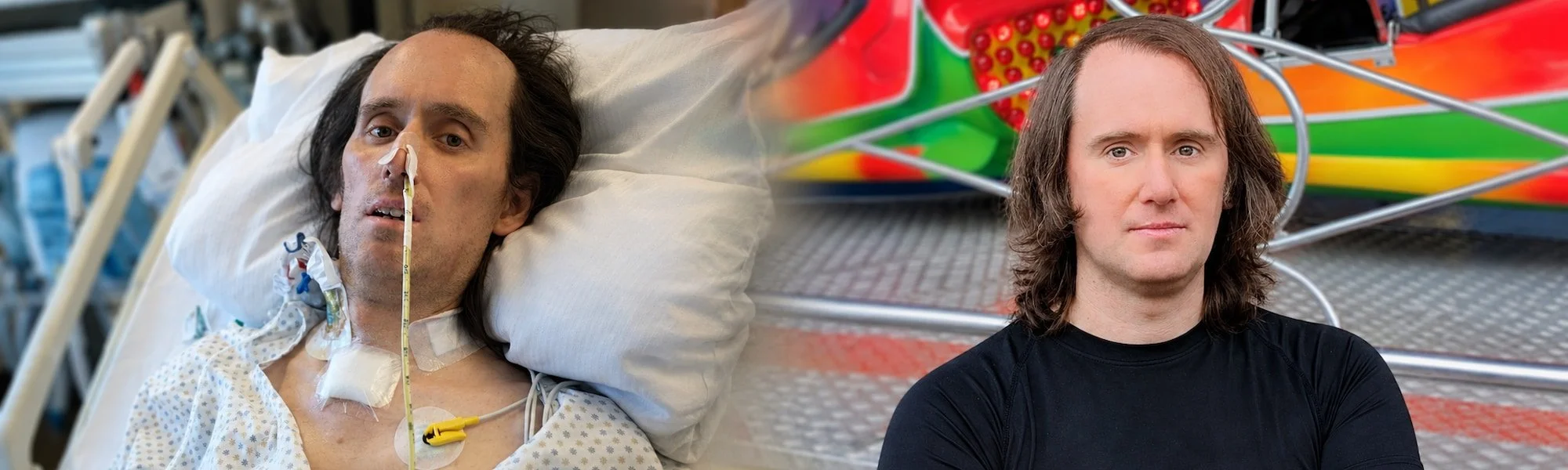
That same night I was transferred to a major hospital because my condition was critical. They took me via helicopter—there was no time for an ambulance. I was connected to an ECMO machine, which is basically an artificial heart and lungs, with a very poor prognosis, and in a coma.
I went into septic shock due to a very aggressive strain of Streptococcus pyogenes, and my body was literally destroying itself. Blood poured from my pores as if I were a fountain. I was swollen like a balloon. My wife was told my survival was a matter of what happened in the following hours.
I woke up about a week later.
As I was trying to make sense of what was going on, strange things began to happen around me. At night, the staff engaged in strange rituals of which I was a part, sometimes with abysmal consequences for me. I was taken outside in the cold to be left for dead, injected with a deadly substance, forced to take part in a perverse “game”, and much more.
Every night was a fight for survival. Nobody understood me, and I felt as helpless as I never imagined I would be. It took an enormous toll mentally and emotionally to see the people that were supposed to help me become my potential executioners. Whether it was reality, medications, fever, or the destruction that was ravaging me, it was as real to me as I’m now alive and writing this.
But I always knew I was going to survive, no matter what. And that gave me strength to endure what was happening inside of me as well as outside.
I lost twenty kilograms due to hypermetabolism—my body was destroying muscular tissue everywhere to get energy for survival. I couldn’t lift my arms, close my mouth or eyes, lost my hair, and my face looked like death itself.
Some weeks went by with sequences of improvement and then worsening, and then the worst thing happened: my appendix ruptured, resulting in a massive four-quadrant peritonitis. I was taken for emergency surgery in a critical condition, but it was either that or letting me die.
In the hours before the surgery, as my body was preparing for the worst, I was in a different world. I was at one side of a valley, with all my ancestors, clashing against what would be best described as forces of evil. Sometimes, I was floating above a river of fire separating dead land from a prairie. Victory—I knew—would be ours, but I’d have to endure the ordeal nevertheless.
My intestines were in such a poor state that, besides the original peritonitis, I had ruptures all around. The surgical team was faced with what is considered the most catastrophic scenario for any abdominal surgery, and they got me through. They were heroes.
However, unbeknownst to me, they’d performed an ileostomy; that is, they left part of the small intestine protruding from my abdomen to collect feces. My large intestine had been disconnected.
I woke up in the surgical ward to a very friendly nurse, and even though I was under the same types of drugs, all those ritualistic sessions stopped. I was more or less in a better state of mind than before, until I discovered what they did to my abdomen. Then I flew into a frenzy, and they not only had to sedate me, but also tie me up.
Even though everything was eventually explained to me and I felt devastated by it, my optimism never went away. I knew all of it was a test set forth by destiny, God, the Universe—whatever name it may have. And that I would succeed because of a series of incredible situations I experienced some time before it all happened.
Nobody understood how I could be so dismissive of the gravity of the situation—they mainly thought I was either insane or so drug-ridden I had no idea what was going on. I made jokes, became friends with the surgical ward team, and was led from one surgery to another with the conviction that I’d always get it through.
The outside world didn’t agree, however. Even though it was almost a miracle I was alive, they said my recovery would take years. I would be—at the very least—until the end of the year in a rehab clinic, possibly more.
I told my wife, “I’ll be back home before the summer is over.” It was mid-spring. She looked at me with pity.
I was so sure of what I was saying and how it differed from what everybody else thought that I had to “pretend to be reasonable” to reduce suspicions around my state of mind.
Many terrible things followed, which accelerated my decline. They all thought I had suffered too much, and that there was little fight left in me. However, my belief—or better said, knowledge—that I was going to survive prevailed, and I got better. Enough, apparently, that they decided to transfer me to a rehab clinic: that was the biggest blow of all.
I was in no condition for it and, three days later, they sent me back to the hospital. It was, once more, devastating, much like a nightmare that never ends. But the team was hellbent on getting me in shape, or else. And then, a bronchoscopy—my third one—changed everything. I felt I could breathe again. For the first time, I could physically feel I was truly getting better.
One week later, I went back to rehab, by mid-April. There, my wife was told it’d take about three months to know what was recoverable. She never told me that, but I would’ve laughed if she did. After all, I’d be out of there before the end of the summer. Even then, reality seemed to point the other way around: I couldn’t stand up, walk, eat, or drink; my voice was destroyed—which affected me profoundly as a singer—and I was severely malnourished. My lungs were filled with mucus and had to be suctioned regularly because I couldn’t cough.
Nevertheless, my progress astounded everyone. Soon enough, I was out of the ICU, in rehab, and into intermediate care. Little by little and with the help of everyone, I started to get out of bed. To sit. To stand on the floor. Then, my first step. Then, a sip of water. Then a bite. I was truly being reborn, cell by cell, action by action.
In no time I was lapping around the service with the help of a rollator and becoming friends with the nurses and therapists. I felt pampered by everyone there, who confessed they were surprised at my recovery.
On June 24th—just three days after the astronomical summer had begun—I was back home. Gone were the “years” of rehab and that three-month assessment of what would be recoverable: my promise was fulfilled. But a long road to recovery was still ahead.
I was determined to get my reconnection surgery as soon as possible, that is, reattaching the small and large intestines to truly become myself once more. The medical team advised caution and that under no circumstances would they perform it before one year had passed. Besides, I’d have to be in an optimal state for such a procedure.
I immediately started outpatient physiotherapy, ergotherapy and speech therapy. I regained my weight, improved my mobility greatly—and dispensed with my wheelchair—, improved my voice considerably, and, to everyone’s disbelief, I was doing a lot better than every prognosis that was thrown around. In fact, I had about a one-percent chance of getting out of it both alive and as an independent being.
Although everything in my body needed recovering, some interesting things started happening as well.
Everyone around me got sick, and I didn’t get anything. I didn’t feel tired or depressed. I wanted to get on a rollercoaster by early August—my wife wouldn’t let me.
I went back to the hospital for studies. Doctors were deeply impressed by how I looked, hugging me in the best example of what everyone involved were: human beings learning from an incredible, extreme experience.
By December, I received a phone call from the hospital. They scheduled my reconnection surgery for February 24th, exactly one year after the initial surgery took place. Hesitantly, I decided to go through with it—by then, I had internalized that the ileostomy had become a part of my life.
This surgery had a profound symbolic meaning: it was finally reconnecting with myself, back to being one.
And so it happened. However, what would be a less-than-one-week hospital stay turned out to be three weeks and two surgeries. Then, it was finally over. I was back. Battle-worn but ready to come out of this experience with a profound new perspective on life and things.
I became stronger, wiser, and resilient. I went to the absolute abyss and came back to share what I learned with the world.
I’m now writing a book about my experiences—the first of at least two—and trying to reach out to those in need. Sometimes the worst wounds aren’t physical, and most people can’t even grasp how deep this truth really goes. I’m also looking for ways to help people go through these ordeals in life, be it health-related or otherwise.
If you’d like to reach out, please send me an email.
The article above was written by Sebastian Schneider and is shared here with his explicit consent. The views in the article do not necessarily represent those of the Global Sepsis Alliance. They are not intended or implied to be a substitute for professional medical advice. The whole team here at the Global Sepsis Alliance and World Sepsis Day wishes to thank him for sharing his story and for fighting to raise awareness for sepsis.